Minutes after posting my last
blog, I received and email from Resolve Uganda with an update (I am on their email list). I responded and invited them to read and comment on the post. They did and it has led to this interview. Please read and mull it over:
Alison, thank you so much for agreeing to do this interview. I threw out on
Twitter that I would be getting the chance to talk to you and it generated a bit of good bit of buzz so I am excited.
Could you first introduce yourself and tell us what you do?My name is Alison Jones (
pictured above) and I'm one of the co-founders of Resolve Uganda, an organization that was created to protect children from being abducted and abused by a rebel army in Uganda by putting pressure on our leaders here to end the war.
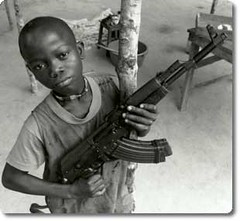
I understand we are mainly talking about Uganda here, but it probably carries across into other countries too. Why the use of child soldiers? What does it accomplish?That's a complicated question that depends largely on the country that we're talking about. While this problem is most critical in Africa, it's also occurring in Asia, Latin America and in parts of Europe and the Middle East. In the case of Uganda, the rebel
Lord's Resistance Army(
LRA) uses child soldiers because they had little to no support from the local population and this was the most expedient way to replenish and fill their ranks. Children make easy prey, and are also easier than adults to brainwash and indoctrinate. The LRA is a case of forcible abduction --- there are other conflicts where children choose (in as much as 11-year olds can make informed decisions) to fight, because they have no other options.
I know civil war was displaced many children in Uganda and groups like Invisible Children are trying to work in that aftermath. What is going on now with the Lord's Resistance Army?While the war between the LRA and Ugandan government has always been commonly viewed as a civil war, there have always been regional components that complicated the situation. The LRA was used as a proxy fighting force by the Sudanese government in its fight against the South Sudanese, and the porous borders in the region allowed the LRA to move freely. The LRA and Ugandan government have been involved in peace negotiations for the past two years that brought relative stability to northern Uganda, but unfortunately this peace came at the expense of other security for other populations in the region. While the negotiations were happening, the LRA took the opportunity to move its bases to the Congo (next door to Uganda) and has recently started committing attacks there that are comparable to what they did in N. Uganda for so long -- abducting children, displacing communities, terrorizing families. This is now very much a regional crisis that the world is going to have to pay attention to and act on if children in Congo and Sudan are going to be spared the same brutal fate that so many children in N. Uganda endured.
I threw out on my last blog post that I did not see the point in legislation because the problem seems to be rebels who would not adhere to laws or proclamations. I would also argue that they would not be the ones affected by restrictions in aid. You disagreed. Could you tell me how it would help?You make a good point that legislation aimed at rebel groups will be ineffective. But just as much as rebel armies use this tactic, so unfortunately do governments (Uganda included). Just yesterday, Congress passed the
Child Soldiers Prevention Act that will limit military funding to governments that recruit and use child soldiers. This is a huge step. In the case of rebel armies, organizations like mine recognize that rebel armies will only abandon this tactic when they are forced to - aka when the conflict is ended. That's why we're doing everything we can to achieve peace for this region - it's the only way kids are going to be safe.
Why should the average person in the Western world care? How/does it affect us?For anyone who has had the chance to listen to the story of a child soldier, whether in a news article, through a movie, or in person, there is a very human component to this. These are just little kids - and whether they live next door or across the ocean - they deserve to be protected. I wholeheartedly believe that this is an issue with no moral uncertainty - what's happening to these children is wrong, and it's no less wrong just because it's not happening right where we live. In addition to that belief though, there is the argument about failed states and what it will take to secure our world. We know that lack of education, extreme poverty, lack of any opportunity breed insecurity - and that this is where armed conflict thrives. I think 9/11 showed most Americans that we need to start paying attention to what's happening in other parts of the world - because our planet is a lot smaller than we think.
How do we get involved, is there anything else we can do besides writing to or representatives in congress?In the case of the LRA, I would encourage people to join our campaign for peace at
www.resolveuganda.org. We were founded on the belief that these kids will be safe only when our politicians care enough to protect them - and that we can make that happen. We organize events all throughout the year that put pressure on our leaders to act for peace. I know that the political process is intimidating to some people, and that writing a letter doesn't sound like the coolest thing to do, but I can promise you that it is the best thing you can do to help these children in the long run.
How does your work differ from that of Invisible Children, another prominent group working for peace in Uganda? Do you ever work together?We do work quite closely with Invisible Children --- As they are working to raise awareness and directly assist children in northern Uganda, we're trying to translate that awareness into political pressure. For every person who sees their film, we want them to call their Member of Congress and ask them to do something. We very much value our collaboration and friendship with their organization and hopefully will have some joint events coming up.
Alison, thank you for your time and very thought provoking answers. This is not an advocacy specific blog but advocacy is an aspect I care deeply about. I would invite you to come back and keep us updated anytime.
For more information, please visit Resolve Uganda by clicking on the logo below:

 I would like you to meet Akua Kusasi. She lives with her family in Offinso in the Ashanti Region of Ghana. She has requested a $550 loan in order to buy maize in bulk so she can expand her business enough to pay for educational opportunities for her children. I have responded to her request in part.